
The 10-million initiative failed and the Swiss abroad rejected it far more sharply
TL;DR
- Swiss voters rejected the SVP’s 10 million initiative 54.8% to 45.2%
- The Yes campaign ran on overcrowding but lost the crowded places
- The Swiss abroad rejected by 14.6% more
On June 14 2026, Swiss voters rejected the SVP’s (also known as UDC, the largest right-wing populist party) initiative to cap the population at 10 million. The No share was 54.79%, and the initiative also failed the required majority of cantons.1

The Yes campaign ran on overcrowding, but drew its weakest support from the places with the most people. It’s ironic that the Yes case was weakest in the very places where its own argument should have been strongest.
The NZZ (Switzerland’s most respected German-language newspaper) analysed the result at commune level and found the correlation runs backwards: the denser a municipality, the lower its Yes share.2 In the core cities, only about 30% backed the initiative; in rural communes, roughly twice that. The political geographer Michael Hermann had predicted exactly this before the vote, arguing that the fear of density is greatest where density does not exist, because a national debate about immigration makes people feel a crowding their own surroundings do not contain.3 Some of the communes that voted Yes are losing population, not gaining it.
The frustration behind the Yes vote looks like it’s cultural rather than infrastructural. That matters for why the cap lost: an initiative sold as relief from crowding had to win the crowded places to win the country, because that is where the votes are. It couldn’t, because there the density argument met the daily experience of the people hearing it and failed the test. We read the geography as a partial cause of the defeat, not just a curiosity — though it is an inference from the pattern, not a proven mechanism.
The SVP’s own coalition shrank. Several cantons it carried in 2014, when its Mass Immigration Initiative narrowly passed, moved into the No column this time, including Schaffhausen, Lucerne, Graubünden, Basel-Land and Bern.4 The party’s president, Marcel Dettling, read the defeat as the cities outvoting the countryside.5 The cantonal map gives him part of that, but it omits the more uncomfortable fact for his party: the heartland it relied on a decade ago has thinned, on the same argument run a second time.
The Swiss abroad voted resoundingly for No
Switzerland publishes no single national tally for citizens abroad, but a number of cantons report the Auslandschweizer vote as a separate unit in the official results, so we isolated that data ourselves. Across the eight cantons that report it in the federal dataset, the diaspora who voted rejected the cap by 69.4% to 30.6%, about 15 points more opposed than residents nationally.6 Geneva’s separately reported diaspora went further still, at 72.2% No.7
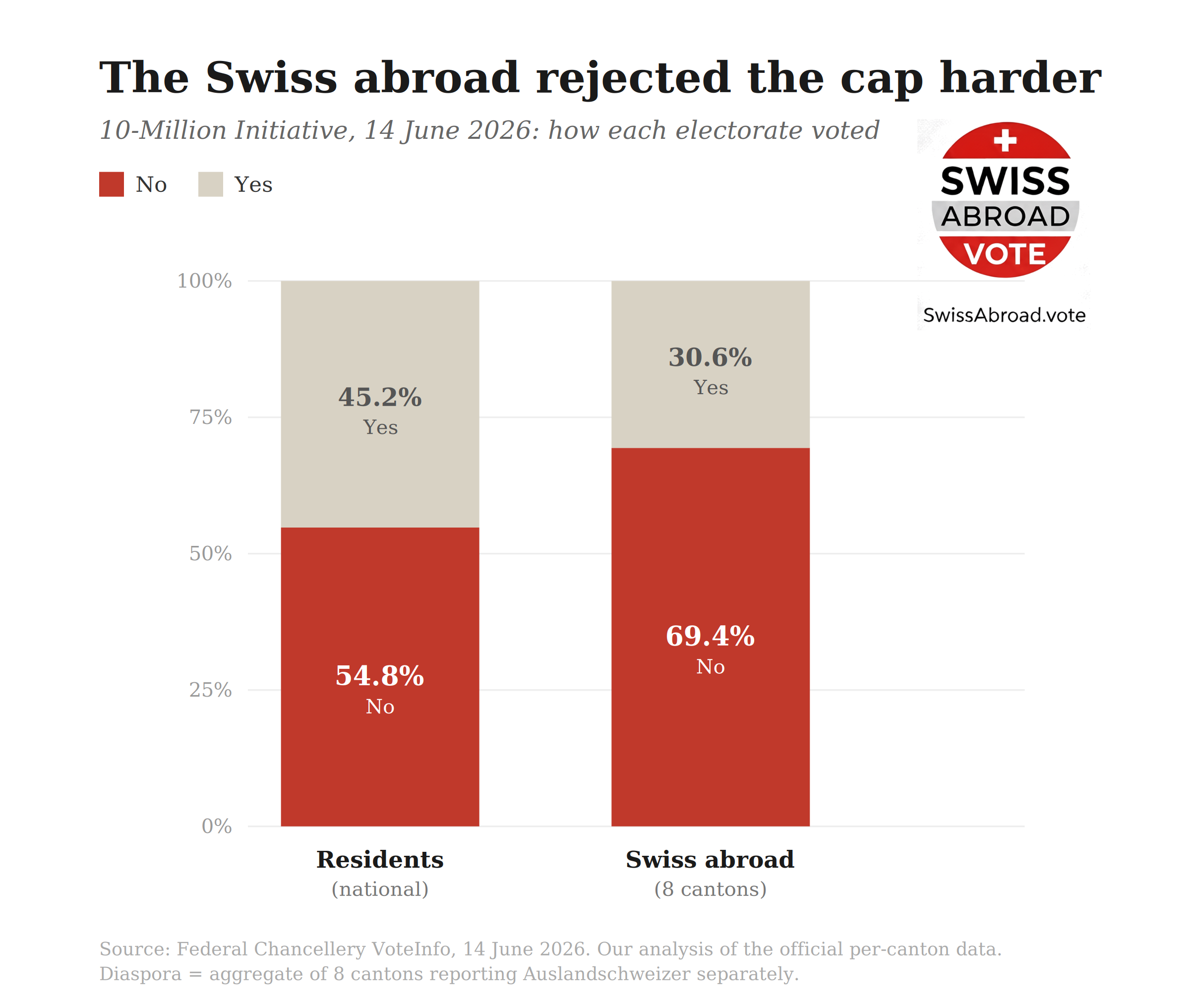
The wrinkle is participation. Diaspora turnout was low, as usual — about 28%, against 58.86% nationally, roughly half the domestic rate.8
The Civilian Service vote
The same ballot tightened the rules for switching from military to civilian service. We recommended No; it passed, 52.46% Yes, and the new rules take effect around mid-2027.9 On this measure our recommendation did not match the outcome. The diaspora here tracked the country rather than diverging from it, at 53% Yes across the reporting cantons.
What’s next
The next federal vote is September 27. The Neutrality Initiative would write “perpetual, armed” neutrality into the constitution, bar Switzerland from any military alliance, and stop the country from joining international sanctions like those it adopted against Russia in 2022.10 The second measure, the Food Security Initiative, would raise the food self-sufficiency target to 70% and push farming toward more plant-based production; the Farmers’ Association opposes it.11 We will follow up with a full guide to both before the postal voting deadlines.
Data sources are drawn from official Federal Chancellery VoteInfo data and cantonal results (Geneva, Basel-Stadt), the Federal Statistical Office turnout series, and Swiss-language coverage (NZZ, Tages-Anzeiger, Le Temps/24heures, SRF, SWI swissinfo.ch). Non-Swiss outlets are used only for international reaction and attributed quotes, never for Swiss procedural facts.
- Federal Chancellery, VoteInfo official results, 14 June 2026: initiative rejected 54.79% No / 45.21% Yes; a majority of cantons opposed, so the initiative failed the Ständemehr. opendata.swiss — VoteInfo real-time federal results dataset: https://opendata.swiss/de/dataset/echtzeitdaten-zu-den-eidgenossischen-abstimmungen-gemeindestand-am-datum-der-abstimmung. [↩]
- NZZ, commune-level analysis of the 10-million result, 15 June 2026: inverse correlation between municipal density and Yes share; roughly 30% Yes in core cities versus about double that in rural communes. Original language: German. nzz.ch: https://www.nzz.ch/visuals/zahlen-zeigen-das-nein-zur-10-millionen-grenze-ist-ein-sieg-der-staedte-ueber-die-laendliche-schweiz-ld.10011267 [↩]
- NZZ, “Die Sorge vor dem Dichtestress ist dort am grössten, wo es ihn gar nicht gibt,” pre-vote, citing political geographer Michael Hermann. Original language: German. nzz.ch: https://www.nzz.ch/schweiz/10-millionen-initiative-die-sorge-vor-dem-dichtestress-ist-dort-am-groessten-wo-es-ihn-gar-nicht-gibt-ld.10008833 [↩]
- Tages-Anzeiger, results analysis, 14–15 June 2026: cantons that backed the 2014 Mass Immigration Initiative shifted to No. Original language: German. tagesanzeiger.ch: https://www.tagesanzeiger.ch/10-millionen-schweiz-stadt-land-graben-in-zofingen-uerkheim-347497935485. [↩]
- Marcel Dettling, SVP president, interviewed by SRF and reported by Reuters/CNBC, 14 June 2026: framed the loss as cities outvoting the countryside. srf.ch: https://www.srf.ch/news/schweiz/stadt-land-graben-svp-wettert-gegen-staedte-dabei-dominiert-meistens-das-land. [↩]
- Federal Chancellery, VoteInfo official dataset, 14 June 2026, Auslandschweizer units for the eight reporting cantons (ZH, AG, SG, BS, LU, TG, AI, UR): our own aggregation gives diaspora 30.6% Yes / 69.4% No on the initiative, 53.0% Yes on the Civil Service Act, and aggregate diaspora turnout of 28.2%. Partial, not a national diaspora figure — eight cantons plus Geneva, not all 26. opendata.swiss — VoteInfo dataset: https://opendata.swiss/de/dataset/echtzeitdaten-zu-den-eidgenossischen-abstimmungen-gemeindestand-am-datum-der-abstimmung; Basel-Stadt breakdown confirmed in the cantonal final-results PDF: https://media.bs.ch/original_file/3513d45263b6ccae898aeb93ba1582ebcbadaa47/w-a-2026-06-14-schlussresultat-eidg.pdf. Full per-canton breakdown (our analysis): https://swissabroad.vote/wp-content/uploads/2026/06/diaspora-data_vote_june14_2026.csv [↩]
- Canton of Geneva, official results, 14 June 2026, “Suisses de l’Étranger” line: 27.83% Yes / 72.17% No, turnout 28.75%. Original language: French. ge.ch: https://www.ge.ch/votations/20260614/federal/1/. [↩]
- National turnout 58.86% (Federal Chancellery, VoteInfo). Cross-checked against the Federal Statistical Office turnout series: this ranks among the highest turnouts in decades — roughly the top 5% of federal votes since 1971, though not the very highest, so earlier “top ten since 1971” characterisations overstate it. bfs.admin.ch — Abstimmungen statistics: https://www.bfs.admin.ch/bfs/de/home/statistiken/politik/abstimmungen.assetdetail.36650608.html. [↩]
- Federal Chancellery, VoteInfo, 14 June 2026: Civil Service Act amendment approved 52.46% Yes / 47.54% No; entry into force expected mid-2027. opendata.swiss — VoteInfo dataset: https://opendata.swiss/de/dataset/echtzeitdaten-zu-den-eidgenossischen-abstimmungen-gemeindestand-am-datum-der-abstimmung. [↩]
- Federal Chancellery initiative text (new Art. 54a) and SWI swissinfo.ch explainer on the Neutrality Initiative; the driver is Switzerland’s 2022 adoption of EU sanctions against Russia. Confirm final ballot title against the admin.ch September vote page. swissinfo.ch: https://www.swissinfo.ch/ger/schweizer-politik/. [↩]
- Volksinitiative “Für eine sichere Ernährung”: 70% self-sufficiency target and a shift toward plant-based production; opposed by the Schweizer Bauernverband. Original language: German. [↩]